NVIDIA CUDA
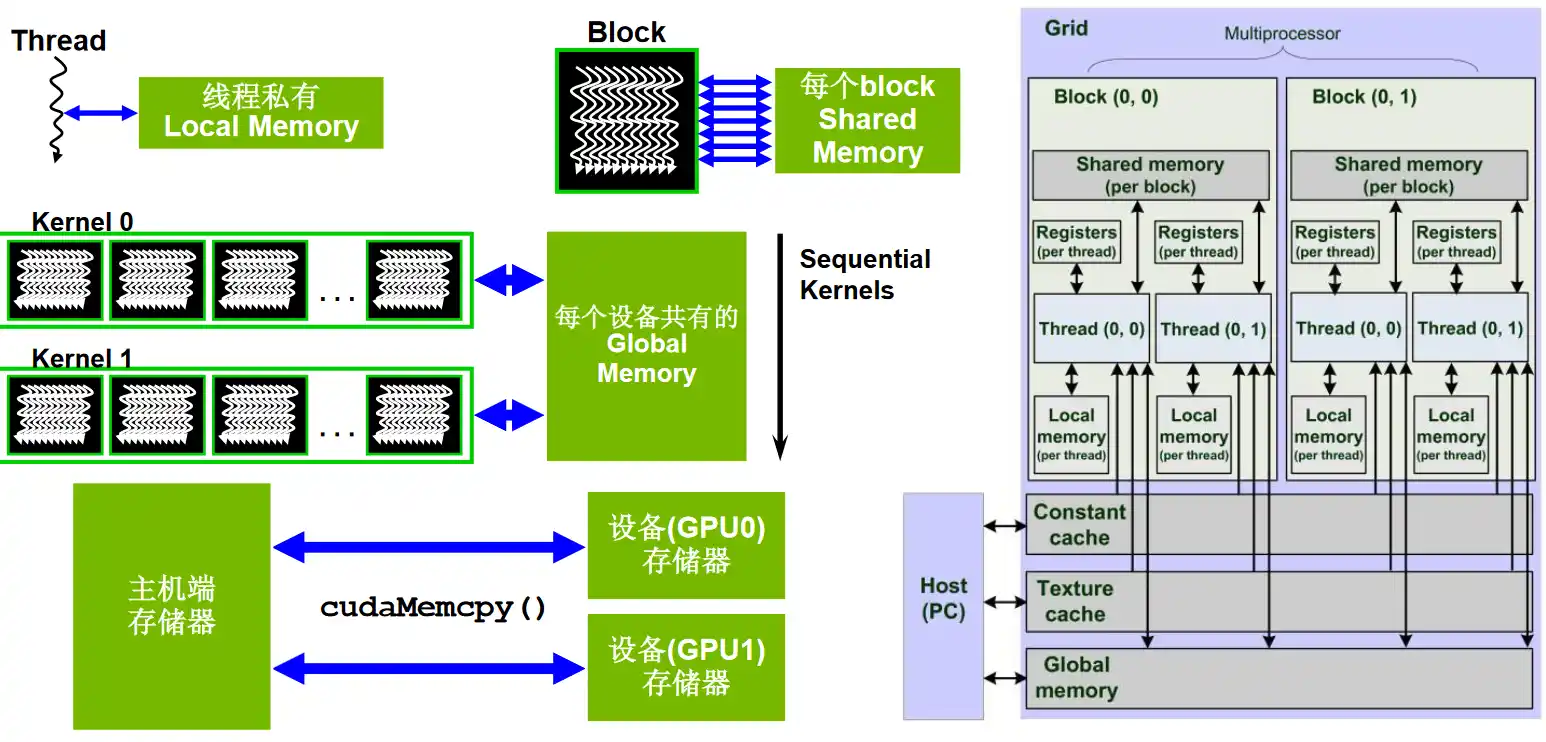
- Global memory:Grid 范围可见。不同 Block 之间通过全局内存交换数据是常见方式(但需要正确的同步手段,通常借助 Kernel 边界或原子/协作组等);
- Shared memory:Block 范围可见。只有同一 Block 的线程能读写同一块 Shared memory;不同 Block 彼此看不到对方的共享内存;
Programming Guide
Error Checking
#define CUDA_CHECK(expr_to_check) do {            \
    cudaError_t result  = expr_to_check;          \
    if(result != cudaSuccess)                     \
    {                                             \
        fprintf(stderr,                           \
                "CUDA Runtime Error: %s:%i:%d = %s\n", \
                __FILE__,                         \
                __LINE__,                         \
                result,\
                cudaGetErrorString(result));      \
    }                                             \
} while(0)
Timer
cudaEvent_t start, stop;
cudaEventCreate(&start);
cudaEventCreate(&stop);

cudaEventRecord(start);
cudaEventQuery(start);

// ...

cudaEventRecord(stop);
cudaEventSynchronize(stop);

float slapsed_time;
cudaEventElapsedTime(&elapsed_time, start, stop);

cudaEventDestroy(start);
cudaEventDestroy(stop);
LeetGPU
Easy
Vector Addition
import torch


# A, B, C are tensors on the GPU
def solve(A: torch.Tensor, B: torch.Tensor, C: torch.Tensor, N: int):
    torch.add(A, B, out=C)
#include <cuda_runtime.h>

__global__ void vector_add(const float* A, const float* B, float* C, int N) {
    int idx = blockDim.x * blockIdx.x + threadIdx.x;
    if (idx < N) {
        C[idx] = A[idx] + B[idx];
    }
}

// A, B, C are device pointers (i.e. pointers to memory on the GPU)
extern "C" void solve(const float* A, const float* B, float* C, int N) {
    int threadsPerBlock = 256;
    int blocksPerGrid = (N + threadsPerBlock - 1) / threadsPerBlock;

    vector_add<<<blocksPerGrid, threadsPerBlock>>>(A, B, C, N);
    cudaDeviceSynchronize();
}
Matrix Multiplication
import torch


# A, B, C are tensors on the GPU
def solve(A: torch.Tensor, B: torch.Tensor, C: torch.Tensor, M: int, N: int, K: int):
    torch.matmul(A, B, out=C)
#include <cuda_runtime.h>

__global__ void matrix_multiplication_kernel(const float* A, const float* B, float* C, int M, int N, int K) {
    int x = blockDim.x * blockIdx.x + threadIdx.x;  // col of C
    int y = blockDim.y * blockIdx.y + threadIdx.y;  // row if C
    if (x >= K || y >= M) {
        return;
    }

    float ans = 0.0;
    for (int i = 0; i < N; ++i) {
        ans += A[i + y * N] * B[x + i * K];
    }
    C[x + y * K] = ans;
}

// A, B, C are device pointers (i.e. pointers to memory on the GPU)
extern "C" void solve(const float* A, const float* B, float* C, int M, int N, int K) {
    dim3 threadsPerBlock(16, 16);
    dim3 blocksPerGrid((K + threadsPerBlock.x - 1) / threadsPerBlock.x,
                       (M + threadsPerBlock.y - 1) / threadsPerBlock.y);

    matrix_multiplication_kernel<<<blocksPerGrid, threadsPerBlock>>>(A, B, C, M, N, K);
    cudaDeviceSynchronize();
}
上面这种访问内存的方法,
-
对于单个线程内部,
x,y固定,i变化,则A的访问缓存友好; -
在 CUDA 硬件中,
threadIdx.x是变化最快的维度,因此同一个 Warp 内的线程,其x坐标必然是连续(或分段连续)的,而y坐标相对稳定。分析合并访问时,对于 Warp 级别,同一循环迭代(i相同),A访问的地址相同(广播),B访问的地址连续(合并访问)
A 的内存访问方式,依赖 L1 缓存广播,如果 N 过大,A 的一行可能超出 L1 缓存,导致缓存抖动,修改为下面这种共享内存的访问方式,
#include <cuda_runtime.h>

#define TILE_SIZE 16

__global__ void matrix_multiplication_kernel(const float* A, const float* B, float* C, int M, int N, int K) {
    int row = blockDim.y * blockIdx.y + threadIdx.y;  // [0, M)
    int col = blockDim.x * blockIdx.x + threadIdx.x;  // [0, K)

    __shared__ float As[TILE_SIZE][TILE_SIZE + 1];
    __shared__ float Bs[TILE_SIZE][TILE_SIZE + 1];

    float acc = 0.0f;
    int num_tiles = (N + TILE_SIZE - 1) / TILE_SIZE;
    for (int i = 0; i < num_tiles; ++i) {
        if (row < M && i * TILE_SIZE + threadIdx.x < N) {
            As[threadIdx.y][threadIdx.x] = A[row * N + i * TILE_SIZE + threadIdx.x];
        } else {
            As[threadIdx.y][threadIdx.x] = 0.0f;  // Boundary Filling
        }

        if (col < K && i * TILE_SIZE + threadIdx.y < N) {
            Bs[threadIdx.y][threadIdx.x] = B[(i * TILE_SIZE + threadIdx.y) * K + col];
        } else {
            Bs[threadIdx.y][threadIdx.x] = 0.0f;  // Boundary Filling
        }

        __syncthreads();

        #pragma unroll
        for (int k = 0; k < TILE_SIZE; ++k) {
            acc += As[threadIdx.y][k] * Bs[k][threadIdx.x];
        }

        __syncthreads();
    }

    if (row < M && col < K) {
        C[row * K + col] = acc;
    }
}

// A, B, C are device pointers (i.e. pointers to memory on the GPU)
extern "C" void solve(const float* A, const float* B, float* C, int M, int N, int K) {
    dim3 threadsPerBlock(16, 16);
    dim3 blocksPerGrid((K + threadsPerBlock.x - 1) / threadsPerBlock.x,
                       (M + threadsPerBlock.y - 1) / threadsPerBlock.y);

    matrix_multiplication_kernel<<<blocksPerGrid, threadsPerBlock>>>(A, B, C, M, N, K);
    cudaDeviceSynchronize();
}
Matrix Transpose
import torch


# input, output are tensors on the GPU
def solve(input: torch.Tensor, output: torch.Tensor, rows: int, cols: int):
    output[:] = input.T
    # output.copy_(input.T)  # PyTorch
#include <cuda_runtime.h>

__global__ void matrix_transpose_kernel(const float* input, float* output, int rows, int cols) {
    int x = blockDim.x * blockIdx.x + threadIdx.x;
    int y = blockDim.y * blockIdx.y  + threadIdx.y;

    if (x < cols && y < rows) {
        output[y + rows * x] = input[x + cols * y];
    }
}

// input, output are device pointers (i.e. pointers to memory on the GPU)
extern "C" void solve(const float* input, float* output, int rows, int cols) {
    dim3 threadsPerBlock(16, 16);
    dim3 blocksPerGrid((cols + threadsPerBlock.x - 1) / threadsPerBlock.x,
                       (rows + threadsPerBlock.y - 1) / threadsPerBlock.y);

    matrix_transpose_kernel<<<blocksPerGrid, threadsPerBlock>>>(input, output, rows, cols);
    cudaDeviceSynchronize();
}
Color Inversion
import torch


# image is a tensor on the GPU
def solve(image: torch.Tensor, width: int, height: int):
    image = image.view(-1,4)
    image[:, 0:3] = 255 - image[:, 0:3]
#include <cuda_runtime.h>

#define INV_MAGIC_NUM 0x00FFFFFF

__global__ void invert_kernel(unsigned char* image, int width, int height) {
    const size_t size = width * height;
    int idx = blockDim.x * blockIdx.x + threadIdx.x;
    unsigned int *image4 = (unsigned int *)image;  // Reverse order
    if (idx < size) {
        image4[idx] ^= INV_MAGIC_NUM;
    }
}
// image_input, image_output are device pointers (i.e. pointers to memory on the GPU)
extern "C" void solve(unsigned char* image, int width, int height) {
    int threadsPerBlock = 256;
    int blocksPerGrid = (width * height + threadsPerBlock - 1) / threadsPerBlock;

    invert_kernel<<<blocksPerGrid, threadsPerBlock>>>(image, width, height);
    cudaDeviceSynchronize();
}
Matrix Addition
import torch


# A, B, C are tensors on the GPU
def solve(A: torch.Tensor, B: torch.Tensor, C: torch.Tensor, N: int):
    torch.add(A, B, out=C)
#include <cuda_runtime.h>

__global__ void matrix_add(const float* A, const float* B, float* C, int N) {
    int x = blockDim.x * blockIdx.x + threadIdx.x;

    if (x < N * N) {
        C[x] = A[x] + B[x];
    }
}

// A, B, C are device pointers (i.e. pointers to memory on the GPU)
extern "C" void solve(const float* A, const float* B, float* C, int N) {
    int threadsPerBlock = 256;
    int blocksPerGrid = (N * N + threadsPerBlock - 1) / threadsPerBlock;

    matrix_add<<<blocksPerGrid, threadsPerBlock>>>(A, B, C, N);
    cudaDeviceSynchronize();
}
1D Convolution
import torch
import torch.nn.functional as F


# input, kernel, output are tensors on the GPU
def solve(
    input: torch.Tensor,
    kernel: torch.Tensor,
    output: torch.Tensor,
    input_size: int,
    kernel_size: int,
):
    assert input.device == kernel.device == output.device
    assert input.dtype == kernel.dtype == output.dtype == torch.float32
    assert input.numel() == input_size
    assert kernel.numel() == kernel_size
    output_size = input_size - kernel_size + 1
    assert output_size >= 1
    assert output.numel() == output_size

    x = input.view(1, 1, input_size)
    k = kernel.view(1, 1, kernel_size)

    with torch.no_grad():
        y = F.conv1d(x, k)
        output.copy_(y.view(-1))
#include <cuda_runtime.h>

__global__ void convolution_1d_kernel(const float *input, const float *kernel,
                                      float *output, int input_size,
                                      int kernel_size) {
    int x = blockDim.x * blockIdx.x + threadIdx.x;
    if (x >= input_size - kernel_size + 1) {
        return;
    }
    float output_kernel = 0.0;
    for (int i = 0; i < kernel_size; ++i) {
        output_kernel += kernel[i] * input[x + i];
    }
    output[x] = output_kernel;
}

// input, kernel, output are device pointers (i.e. pointers to memory on the GPU)
extern "C" void solve(const float* input, const float* kernel, float* output, int input_size,
                      int kernel_size) {
    int output_size = input_size - kernel_size + 1;
    int threadsPerBlock = 256;
    int blocksPerGrid = (output_size + threadsPerBlock - 1) / threadsPerBlock;

    convolution_1d_kernel<<<blocksPerGrid, threadsPerBlock>>>(input, kernel, output, input_size,
                                                              kernel_size);
    cudaDeviceSynchronize();
}
下面使用共享内存缓存卷积核,
#include <cuda_runtime.h>

__global__ void convolution_1d_kernel(const float *__restrict__ input, const float *__restrict__ kernel,
                                      float *__restrict__ output, int input_size, int kernel_size) {
    int x = blockDim.x * blockIdx.x + threadIdx.x;
    if (x >= input_size - kernel_size + 1) {
        return;
    }

    extern __shared__ float shared_kernel[];

    for (int i = threadIdx.x; i < kernel_size; ++i) {
        shared_kernel[i] = kernel[i];
    }
    __syncthreads();

    float output_kernel = 0.0f;
    #pragma unroll
    for (int i = 0; i < kernel_size; ++i) {
        output_kernel += shared_kernel[i] * __ldg(&input[x + i]);
    }
    output[x] = output_kernel;
}

// input, kernel, output are device pointers (i.e. pointers to memory on the GPU)
extern "C" void solve(const float* input, const float* kernel, float* output, int input_size,
                      int kernel_size) {
    int output_size = input_size - kernel_size + 1;
    int threadsPerBlock = 256;
    int blocksPerGrid = (output_size + threadsPerBlock - 1) / threadsPerBlock;

    size_t shared_mem_size = kernel_size * sizeof(float);
    convolution_1d_kernel<<<blocksPerGrid, threadsPerBlock, shared_mem_size>>>(input, kernel, output, input_size,
                                                              kernel_size);
    cudaDeviceSynchronize();
}
Reverse Array
import torch


# input is a tensor on the GPU
def solve(input: torch.Tensor, N: int):
    input.copy_(torch.flip(input, dims=[0]))
#include <cuda_runtime.h>

__global__ void reverse_array(float* input, int N) {
    int x = blockIdx.x * blockDim.x + threadIdx.x;
    if (x < N / 2) {
        float tmp = 0.0;
        tmp = input[x];
        input[x] = input[N - 1 - x];
        input[N - 1 - x] = tmp;
    }
}

// input is device pointer
extern "C" void solve(float* input, int N) {
    int threadsPerBlock = 256;
    int blocksPerGrid = (N + threadsPerBlock - 1) / threadsPerBlock;

    reverse_array<<<blocksPerGrid, threadsPerBlock>>>(input, N);
    cudaDeviceSynchronize();
}
ReLU
import torch


# input, output are tensors on the GPU
def solve(input: torch.Tensor, output: torch.Tensor, N: int):
    torch.clamp(input, min=0, out=output)
#include <cuda_runtime.h>

__global__ void relu_kernel(const float* input, float* output, int N) {
    int x = blockDim.x * blockIdx.x + threadIdx.x;
    if (x < N) {
        output[x] = input[x] > 0 ? input[x] : 0;
    }
}

// input, output are device pointers (i.e. pointers to memory on the GPU)
extern "C" void solve(const float* input, float* output, int N) {
    int threadsPerBlock = 256;
    int blocksPerGrid = (N + threadsPerBlock - 1) / threadsPerBlock;

    relu_kernel<<<blocksPerGrid, threadsPerBlock>>>(input, output, N);
    cudaDeviceSynchronize();
}
Leaky ReLU
import torch


# input, output are tensors on the GPU
def solve(input: torch.Tensor, output: torch.Tensor, N: int):
    output.copy_(torch.where(input >= 0, input, 0.01 * input))
#include <cuda_runtime.h>

__global__ void leaky_relu_kernel(const float* input, float* output, int N) {
    int x = blockDim.x * blockIdx.x + threadIdx.x;
    if (x < N) {
        output[x] = input[x] > 0.0f ? input[x] : 0.01f * input[x];
    }
}

// input, output are device pointers (i.e. pointers to memory on the GPU)
extern "C" void solve(const float* input, float* output, int N) {
    int threadsPerBlock = 256;
    int blocksPerGrid = (N + threadsPerBlock - 1) / threadsPerBlock;

    leaky_relu_kernel<<<blocksPerGrid, threadsPerBlock>>>(input, output, N);
    cudaDeviceSynchronize();
}
Rainbow Table
import torch


def fnv1a_hash(x: torch.Tensor) -> torch.Tensor:
    FNV_PRIME = 16777619
    OFFSET_BASIS = 2166136261
    x_int = x.to(torch.int64)
    hash_val = torch.full_like(x_int, OFFSET_BASIS, dtype=torch.int64)

    for byte_pos in range(4):
        byte = (x_int >> (byte_pos * 8)) & 0xFF
        hash_val = (hash_val ^ byte) * FNV_PRIME
        hash_val = hash_val & 0xFFFFFFFF

    return hash_val.to(torch.int32)


# input, output are tensors on the GPU
def solve(input: torch.Tensor, output: torch.Tensor, N: int, R: int):
    for _ in range(R):
        input = fnv1a_hash(input)
        output.copy_(input)
#include <cuda_runtime.h>

__device__ unsigned int fnv1a_hash(int input) {
    const unsigned int FNV_PRIME = 16777619;
    const unsigned int OFFSET_BASIS = 2166136261;

    unsigned int hash = OFFSET_BASIS;

    for (int byte_pos = 0; byte_pos < 4; byte_pos++) {
        unsigned char byte = (input >> (byte_pos * 8)) & 0xFF;
        hash = (hash ^ byte) * FNV_PRIME;
    }

    return hash;
}

__global__ void fnv1a_hash_kernel(const int* input, unsigned int* output, int N, int R) {
    int x = blockDim.x * blockIdx.x + threadIdx.x;
    if (x < N) {
        output[x] = input[x];
        for (int i = 0; i < R; ++i) {
            output[x] = fnv1a_hash(output[x]);
        }
    }
}

// input, output are device pointers (i.e. pointers to memory on the GPU)
extern "C" void solve(const int* input, unsigned int* output, int N, int R) {
    int threadsPerBlock = 256;
    int blocksPerGrid = (N + threadsPerBlock - 1) / threadsPerBlock;

    fnv1a_hash_kernel<<<blocksPerGrid, threadsPerBlock>>>(input, output, N, R);
    cudaDeviceSynchronize();
}
Matrix Copy
import torch


# A, B are tensors on the GPU
def solve(A: torch.Tensor, B: torch.Tensor, N: int):
    B.copy_(A)
#include <cuda_runtime.h>

__global__ void copy_matrix_kernel(const float* A, float* B, int N) {
    int x = blockDim.x * blockIdx.x + threadIdx.x;
    if (x < N * N) {
        B[x] = A[x];
    }

}

// A, B are device pointers (i.e. pointers to memory on the GPU)
extern "C" void solve(const float* A, float* B, int N) {
    int total = N * N;
    int threadsPerBlock = 256;
    int blocksPerGrid = (total + threadsPerBlock - 1) / threadsPerBlock;
    copy_matrix_kernel<<<blocksPerGrid, threadsPerBlock>>>(A, B, N);
    cudaDeviceSynchronize();
}

////////////////////////////////////////////////////////////////////////////////

#include <cuda_runtime.h>

extern "C" void solve(const float* A, float* B, int N) {
    size_t bytes = N * N * sizeof(float);
    cudaMemcpy(B, A, bytes, cudaMemcpyDeviceToDevice);
}
Simple Inference
import torch
import torch.nn as nn


# input, model, and output are on the GPU
def solve(input: torch.Tensor, model: nn.Module, output: torch.Tensor):
    with torch.no_grad():
        output.copy_(model(input))
Count Array Element
import torch


# input, output are tensors on the GPU
def solve(input: torch.Tensor, output: torch.Tensor, N: int, K: int):
    output.copy_(torch.sum(input == K))
#include <cuda_runtime.h>

/******************************************************************************/
__global__ void count_equal_kernel(const int* input, int* output, int N, int K) {
    int x = blockDim.x * blockIdx.x + threadIdx.x;
    if (x < N) {
        if (input[x] == K) {
            atomicAdd(output, 1);
        }
    }
}
/******************************************************************************/
// 共享内存 + 并行规约
__global__ void count_equal_kernel(const int* input, int* output, int N, int K) {
    int x = blockDim.x * blockIdx.x + threadIdx.x;
    int tid = threadIdx.x;
    __shared__ int block_cnt[256];
    int local_cnt = 0;
    if (x < N && input[x] == K) {
        local_cnt = 1;
    }
    block_cnt[tid] = local_cnt;
    __syncthreads();

    for (int stride = blockDim.x / 2; stride > 0; stride >>= 1) {
        if (tid < stride) {
            block_cnt[tid] += block_cnt[tid + stride];
        }
        __syncthreads();
    }

    if (tid == 0 && block_cnt[0] > 0) {
        atomicAdd(output, block_cnt[0]);
    }
}
/******************************************************************************/
// warp 内部 Shuffle 规约
__device__ __forceinline__ int warp_reduce_sum(int val) {
    for (int offset = 16; offset > 0; offset >>= 1) {
        val += __shfl_down_sync(0xFFFFFFFF, val, offset);
    }

    return val;
}

__global__ void count_equal_kernel(const int* input, int* output, int N, int K) {
    int x = blockDim.x * blockIdx.x + threadIdx.x;
    int tid = threadIdx.x;
    int lane = tid % 32;
    int warp_id = tid / 32;

    int local_cnt = (x < N && input[x] == K) ? 1 : 0;
    local_cnt = warp_reduce_sum(local_cnt);
    __shared__ int warp_cnt[8];  // 256 / 32 = 8 warps
    if (lane == 0) {
        warp_cnt[warp_id] = local_cnt;
    }
    __syncthreads();

    if (warp_id == 0) {
        int val = (lane < 8) ? warp_cnt[lane] : 0;
        val = warp_reduce_sum(val);

        if (lane == 0 && val > 0) {
            atomicAdd(output, val);
        }
    }
}
/******************************************************************************/

// input, output are device pointers (i.e. pointers to memory on the GPU)
extern "C" void solve(const int* input, int* output, int N, int K) {
    int threadsPerBlock = 256;
    int blocksPerGrid = (N + threadsPerBlock - 1) / threadsPerBlock;

    count_equal_kernel<<<blocksPerGrid, threadsPerBlock>>>(input, output, N, K);
    cudaDeviceSynchronize();
}
Count 2D Array Element
import torch


# input, output are tensors on the GPU
def solve(input: torch.Tensor, output: torch.Tensor, N: int, M: int, K: int):
    output.copy_(torch.sum(input.flatten() == K))
#include <cuda_runtime.h>

__global__ void count_2d_equal_kernel(const int* input, int* output, int N, int M, int K) {
    int x = blockDim.x * blockIdx.x + threadIdx.x;
    int y = blockDim.y * blockIdx.y + threadIdx.y;
    if (y < N && x < M && input[y*M + x] == K) {
        atomicAdd(output, 1);
    }
}

// input, output are device pointers (i.e. pointers to memory on the GPU)
extern "C" void solve(const int* input, int* output, int N, int M, int K) {
    dim3 threadsPerBlock(16, 16);
    dim3 blocksPerGrid((M + threadsPerBlock.x - 1) / threadsPerBlock.x,
                       (N + threadsPerBlock.y - 1) / threadsPerBlock.y);

    count_2d_equal_kernel<<<blocksPerGrid, threadsPerBlock>>>(input, output, N, M, K);
    cudaDeviceSynchronize();
}
Sigmoid Linear Unit
import torch


# input, output are tensors on the GPU
def solve(input: torch.Tensor, output: torch.Tensor, N: int):
    torch.mul(input, torch.sigmoid(input), out=output)
#include <cuda_runtime.h>

__global__ void silu_kernel(const float* input, float* output, int N) {
    int x = blockDim.x * blockIdx.x + threadIdx.x;
    if (x < N) {
        output[x] = input[x] / (1 + expf(-input[x]));
    }
}

// input, output are device pointers
extern "C" void solve(const float* input, float* output, int N) {
    int threadsPerBlock = 256;
    int blocksPerGrid = (N + threadsPerBlock - 1) / threadsPerBlock;

    silu_kernel<<<blocksPerGrid, threadsPerBlock>>>(input, output, N);
    cudaDeviceSynchronize();
}
Swish-Gated Linear Unit
import torch


# input, output are tensors on the GPU
def solve(input: torch.Tensor, output: torch.Tensor, N: int):
    x1, x2 = input[:N//2], input[N//2:]
    torch.mul(x1 * torch.nn.functional.sigmoid(x1), x2, out=output)
#include <cuda_runtime.h>

__global__ void swiglu_kernel(const float* input, float* output, int halfN) {
    int x = blockDim.x * blockIdx.x + threadIdx.x;
    if (x < halfN) {
        float silu = input[x] * (1 / (1 + expf(-input[x])));
        output[x] = silu * input[x+ halfN];
    }
}

// input, output are device pointers
extern "C" void solve(const float* input, float* output, int N) {
    int halfN = N / 2;
    int threadsPerBlock = 256;
    int blocksPerGrid = (halfN + threadsPerBlock - 1) / threadsPerBlock;

    swiglu_kernel<<<blocksPerGrid, threadsPerBlock>>>(input, output, halfN);
    cudaDeviceSynchronize();
}
Value Clipping
import torch


# input, output are tensors on the GPU
def solve(input: torch.Tensor, output: torch.Tensor, lo: float, hi: float, N: int):
    torch.clamp(input, lo, hi, out=output)
#include <cuda_runtime.h>

__global__ void clip_kernel(const float* input, float* output, float lo, float hi, int N) {
    int x = blockDim.x * blockIdx.x + threadIdx.x;
    if (x < N) {
        output[x] = fmaxf(fminf(input[x], hi), lo);
    }
}

// input, output are device pointers
extern "C" void solve(const float* input, float* output, float lo, float hi, int N) {
    int threadsPerBlock = 256;
    int blocksPerGrid = (N + threadsPerBlock - 1) / threadsPerBlock;

    clip_kernel<<<blocksPerGrid, threadsPerBlock>>>(input, output, lo, hi, N);
    cudaDeviceSynchronize();
}
Interleave Arrays
import torch


# A, B, output are tensors on the GPU
def solve(A: torch.Tensor, B: torch.Tensor, output: torch.Tensor, N: int):
    # output[0::2] = A
    # output[1::2] = B
    output.data = torch.stack([A, B], dim=1).flatten()
#include <cuda_runtime.h>

__global__ void interleave_kernel(const float* A, const float* B, float* output, int N) {
    int x = blockDim.x * blockIdx.x + threadIdx.x;
    if (x < N) {
        output[x * 2] = A[x];
        output[2 * x + 1] = B[x];
    }
}

// A, B, output are device pointers (i.e. pointers to memory on the GPU)
extern "C" void solve(const float* A, const float* B, float* output, int N) {
    int threadsPerBlock = 256;
    int blocksPerGrid = (N + threadsPerBlock - 1) / threadsPerBlock;

    interleave_kernel<<<blocksPerGrid, threadsPerBlock>>>(A, B, output, N);
    cudaDeviceSynchronize();
}
Gaussian Error Gated Linear Unit
import torch
import torch.nn.functional as F

# input, output are tensors on the GPU
def solve(input: torch.Tensor, output: torch.Tensor, N: int):
    output.copy_(input[:N//2] * F.gelu(input[N//2:]))
#include <cuda_runtime.h>

__global__ void geglu_kernel(const float* input, float* output, int halfN) {
    int x = blockDim.x * blockIdx.x + threadIdx.x;
    if (x < halfN){
        output[x] = input[x] * 0.5f * input[x + halfN] * (1.0f + erff(input[x + halfN] * 0.7071067811865475f));
    }
}

// input, output are device pointers
extern "C" void solve(const float* input, float* output, int N) {
    int halfN = N / 2;
    int threadsPerBlock = 256;
    int blocksPerGrid = (halfN + threadsPerBlock - 1) / threadsPerBlock;

    geglu_kernel<<<blocksPerGrid, threadsPerBlock>>>(input, output, halfN);
    cudaDeviceSynchronize();
}
RGB to Grayscale
import torch


# input, output are tensors on the GPU
def solve(input: torch.Tensor, output: torch.Tensor, width: int, height: int):
    output[:] = 0.299 * input[0::3] + 0.587 * input[1::3] + 0.114 * input[2::3]
#include <cuda_runtime.h>

__global__ void rgb_to_grayscale_kernel(const float* input, float* output, int width, int height) {
    int x = blockDim.x * blockIdx.x + threadIdx.x;
    if (x < width * height) {
        int x3 = x * 3;
        output[x] = input[x3] * 0.299 + input[x3 + 1] * 0.587 + input[x3 + 2] * 0.114;
    }
}

// input, output are device pointers
extern "C" void solve(const float* input, float* output, int width, int height) {
    int total_pixels = width * height;
    int threadsPerBlock = 256;
    int blocksPerGrid = (total_pixels + threadsPerBlock - 1) / threadsPerBlock;

    rgb_to_grayscale_kernel<<<blocksPerGrid, threadsPerBlock>>>(input, output, width, height);
    cudaDeviceSynchronize();
}
Sigmoid Activation
import torch


# X, Y are tensors on the GPU
def solve(X: torch.Tensor, Y: torch.Tensor, N: int):
    torch.sigmoid(X, out=Y)
#include <cuda_runtime.h>
#include <math.h>

__global__ void sigmoid_kernel(const float* X, float* Y, int N) {
    int x = blockDim.x * blockIdx.x + threadIdx.x;
    if (x >= N) {
        return;
    }
    Y[x] = 1 / (1 + expf(-X[x]));
}

// X, Y are device pointers (i.e. pointers to memory on the GPU)
extern "C" void solve(const float* X, float* Y, int N) {
    int threadsPerBlock = 256;
    int blocksPerGrid = (N + threadsPerBlock - 1) / threadsPerBlock;

    sigmoid_kernel<<<blocksPerGrid, threadsPerBlock>>>(X, Y, N);
    cudaDeviceSynchronize();
}
Medium
Reduction
import torch


# input, output are tensors on the GPU
def solve(input: torch.Tensor, output: torch.Tensor, N: int):
    output.copy_(input.sum())
#include <cuda_runtime.h>

#define BLOCK_SIZE 256
#define ELEMENTS_PER_THREAD 8

// 蝶形规约
__device__ __forceinline__ float warpReduceSum(float val) {
    val += __shfl_down_sync(0xFFFFFFFF, val, 16);
    val += __shfl_down_sync(0xFFFFFFFF, val, 8);
    val += __shfl_down_sync(0xFFFFFFFF, val, 4);
    val += __shfl_down_sync(0xFFFFFFFF, val, 2);
    val += __shfl_down_sync(0xFFFFFFFF, val, 1);

    return val; // lane 0
}

__global__ __launch_bounds__(BLOCK_SIZE)
void reduceKernel(const float* __restrict__ input, float* __restrict__ output, int N) {
    __shared__ float warpSums[BLOCK_SIZE / 32];  // 8 float

    float sum = 0.0f;
    int base = blockIdx.x * (BLOCK_SIZE * ELEMENTS_PER_THREAD) + threadIdx.x;
    #pragma unroll
    for (int i = 0; i < ELEMENTS_PER_THREAD; ++i) {
        int idx = base + i * BLOCK_SIZE;
        if (idx < N) {
            sum += input[idx];
        }
    }
    sum = warpReduceSum(sum);
    int lane = threadIdx.x & 31;
    int wid  = threadIdx.x >> 5;
    if (lane == 0) {
        warpSums[wid] = sum;
    }
    __syncthreads();

    if (wid == 0) {
        sum = (threadIdx.x < (BLOCK_SIZE / 32)) ? warpSums[lane] : 0.0f;
        sum = warpReduceSum(sum);

        if (threadIdx.x == 0) {
            output[blockIdx.x] = sum;
        }
    }
}

__global__ __launch_bounds__(BLOCK_SIZE)
void reduceFinalKernel(const float* __restrict__ input, float* __restrict__ output, int N) {
    __shared__ float warpSums[BLOCK_SIZE / 32];

    float sum = 0.0f;
    for (int i = blockIdx.x * BLOCK_SIZE + threadIdx.x; i < N; i += blockDim.x * gridDim.x) {
        sum += input[i];
    }

    sum = warpReduceSum(sum);

    int lane = threadIdx.x & 31;
    int wid  = threadIdx.x >> 5;
    if (lane == 0) {
        warpSums[wid] = sum;
    }
    __syncthreads();

    if (wid == 0) {
        sum = (threadIdx.x < (BLOCK_SIZE / 32)) ? warpSums[lane] : 0.0f;
        sum = warpReduceSum(sum);

        if (threadIdx.x == 0) {
            atomicAdd(output, sum);
        }
    }
}

extern "C" void solve(const float* input, float* output, int N) {
    if (N <= 0) {
        cudaMemset(output, 0, sizeof(float));
        return;
    }

    int elemsPerBlock = BLOCK_SIZE * ELEMENTS_PER_THREAD;     // 256 * 8 = 2048
    int numBlocks = (N + elemsPerBlock - 1) / elemsPerBlock;  // Round up

    if (numBlocks == 1) {
        reduceKernel<<<1, BLOCK_SIZE>>>(input, output, N);
    } else {
        float* partial = nullptr;
        cudaMalloc(&partial, numBlocks * sizeof(float));

        reduceKernel<<<numBlocks, BLOCK_SIZE>>>(input, partial, N);
        int finalBlocks = (numBlocks + elemsPerBlock - 1) / elemsPerBlock;
        if (finalBlocks <= 1) {
            reduceKernel<<<1, BLOCK_SIZE>>>(partial, output, numBlocks);
        } else {
            cudaMemset(output, 0, sizeof(float));
            reduceFinalKernel<<<finalBlocks, BLOCK_SIZE>>>(partial, output, numBlocks);
        }

        cudaFree(partial);
    }
}
Softmax
import torch


# input, output are tensors on the GPU
def solve(input: torch.Tensor, output: torch.Tensor, N: int):
    output.copy_(torch.nn.functional.softmax(input, dim=-1))
#include <cuda_runtime.h>
#include <math.h>

#define BLOCK_SIZE 256
#define NUM_WARPS (BLOCK_SIZE / 32)

__device__ __forceinline__ float warpReduceMax(float val) {
    val = fmaxf(val, __shfl_down_sync(0xFFFFFFFF, val, 16));
    val = fmaxf(val, __shfl_down_sync(0xFFFFFFFF, val, 8));
    val = fmaxf(val, __shfl_down_sync(0xFFFFFFFF, val, 4));
    val = fmaxf(val, __shfl_down_sync(0xFFFFFFFF, val, 2));
    val = fmaxf(val, __shfl_down_sync(0xFFFFFFFF, val, 1));

    return val;
}

__device__ __forceinline__ float warpReduceSum(float val) {
    val += __shfl_down_sync(0xFFFFFFFF, val, 16);
    val += __shfl_down_sync(0xFFFFFFFF, val, 8);
    val += __shfl_down_sync(0xFFFFFFFF, val, 4);
    val += __shfl_down_sync(0xFFFFFFFF, val, 2);
    val += __shfl_down_sync(0xFFFFFFFF, val, 1);

    return val;
}

// ============ Kernel 1: Parallel Max Reduction ============
__global__ __launch_bounds__(BLOCK_SIZE)
void reduceMaxKernel(const float* __restrict__ input, float* __restrict__ output, int N) {
    __shared__ float sdata[NUM_WARPS];

    float maxVal = -INFINITY;
    for (int i = blockIdx.x * blockDim.x + threadIdx.x; i < N; i += blockDim.x * gridDim.x) {
        maxVal = fmaxf(maxVal, input[i]);
    }

    maxVal = warpReduceMax(maxVal);

    int lane = threadIdx.x & 31;
    int wid  = threadIdx.x >> 5;
    if (lane == 0) sdata[wid] = maxVal;
    __syncthreads();

    if (wid == 0) {
        maxVal = (lane < NUM_WARPS) ? sdata[lane] : -INFINITY;
        maxVal = warpReduceMax(maxVal);
        if (lane == 0) output[blockIdx.x] = maxVal;
    }
}

// ============ Kernel 2: exp(x - max) and partial sum ============
__global__ __launch_bounds__(BLOCK_SIZE)
void expAndSumKernel(const float* __restrict__ input, float* __restrict__ output,
                     const float* __restrict__ d_max, float* __restrict__ partialSums, int N) {
    __shared__ float sdata[NUM_WARPS];
    float maxVal = d_max[0];

    float localSum = 0.0f;
    for (int i = blockIdx.x * blockDim.x + threadIdx.x; i < N; i += blockDim.x * gridDim.x) {
        float val = expf(input[i] - maxVal);
        output[i] = val;
        localSum += val;
    }

    localSum = warpReduceSum(localSum);

    int lane = threadIdx.x & 31;
    int wid  = threadIdx.x >> 5;
    if (lane == 0) sdata[wid] = localSum;
    __syncthreads();

    if (wid == 0) {
        localSum = (lane < NUM_WARPS) ? sdata[lane] : 0.0f;
        localSum = warpReduceSum(localSum);
        if (lane == 0) partialSums[blockIdx.x] = localSum;
    }
}

// ============ Kernel 3: Reduce partial sums ============
__global__ __launch_bounds__(BLOCK_SIZE)
void reduceSumKernel(const float* __restrict__ input, float* __restrict__ output, int N) {
    __shared__ float sdata[NUM_WARPS];

    float sum = 0.0f;
    for (int i = blockIdx.x * blockDim.x + threadIdx.x; i < N; i += blockDim.x * gridDim.x) {
        sum += input[i];
    }

    sum = warpReduceSum(sum);

    int lane = threadIdx.x & 31;
    int wid  = threadIdx.x >> 5;
    if (lane == 0) sdata[wid] = sum;
    __syncthreads();

    if (wid == 0) {
        sum = (lane < NUM_WARPS) ? sdata[lane] : 0.0f;
        sum = warpReduceSum(sum);
        if (lane == 0) output[0] = sum;
    }
}

// ============ Kernel 4: Normalize ============
__global__ __launch_bounds__(BLOCK_SIZE)
void normalizeKernel(float* __restrict__ data, const float* __restrict__ d_sum, int N) {
    float invSum = 1.0f / d_sum[0];
    for (int i = blockIdx.x * blockDim.x + threadIdx.x; i < N; i += blockDim.x * gridDim.x) {
        data[i] *= invSum;
    }
}

//XXX Unused
__global__ void softmax_kernel(const float* input, float* output, int N) {}

extern "C" void solve(const float* input, float* output, int N) {
    if (N <= 0) return;

    int numBlocks = min((N + BLOCK_SIZE - 1) / BLOCK_SIZE, 1024);

    float *d_partial, *d_scalar;
    cudaMalloc(&d_partial, numBlocks * sizeof(float));
    cudaMalloc(&d_scalar, sizeof(float));

    // Step 1: Find max(input)
    reduceMaxKernel<<<numBlocks, BLOCK_SIZE>>>(input, d_partial, N);
    reduceMaxKernel<<<1, BLOCK_SIZE>>>(d_partial, d_scalar, numBlocks);

    // Step 2: Compute exp(x_i - max) → output, and partial sums
    expAndSumKernel<<<numBlocks, BLOCK_SIZE>>>(input, output, d_scalar, d_partial, N);

    // Step 3: Reduce partial sums → total sum
    reduceSumKernel<<<1, BLOCK_SIZE>>>(d_partial, d_scalar, numBlocks);

    // Step 4: Normalize output[i] /= sum
    normalizeKernel<<<numBlocks, BLOCK_SIZE>>>(output, d_scalar, N);

    cudaFree(d_partial);
    cudaFree(d_scalar);
}
Softmax Attention
import torch
import torch.nn.functional as F


# Q, K, V, output are tensors on the GPU
def solve(Q: torch.Tensor, K: torch.Tensor, V: torch.Tensor, output: torch.Tensor,
          M: int, N: int, d: int):
      output.copy_((F.softmax(Q @ K.T / (d ** 0.5), dim=1)@V))
#include <cuda_runtime.h>
#include <device_launch_parameters.h>
#include <math.h>
#include <stdio.h>

#define CUDA_CHECK(expr_to_check)                                              \
    do {                                                                       \
        cudaError_t result = expr_to_check;                                    \
        if (result != cudaSuccess) {                                           \
            fprintf(stderr, "CUDA Runtime Error: %s:%i:%d = %s\n", __FILE__,   \
                    __LINE__, result, cudaGetErrorString(result));             \
        }                                                                      \
    } while (0)

__device__ __forceinline__ float warp_reduce_max(float val) {
#pragma unroll
    for (int offset = warpSize / 2; offset > 0; offset >>= 1) {
        val = fmaxf(val, __shfl_down_sync(0xffffffff, val, offset));
    }

    return val;
}

__device__ __forceinline__ float warp_reduce_sum(float val) {
#pragma unroll
    for (int offset = warpSize / 2; offset > 0; offset >>= 1) {
        val += __shfl_down_sync(0xffffffff, val, offset);
    }
    return val;
}

/**
 * Kernel1:
 * Q * K^T -> Scores
 * (M * d)(N * d) -> (M * N)
 *
 */
__global__ void matmul_qk(const float *Q, const float *K, float *Scores, int M,
                          int N, int d) {
    int x = blockDim.x * blockIdx.x + threadIdx.x; // [0, N)
    int y = blockDim.y * blockIdx.y + threadIdx.y; // [0, M)
    if (x >= N || y >= M) {
        return;
    }
    float dot = 0.0f;
    for (int i = 0; i < d; ++i) {
        dot += Q[y * d + i] * K[x * d + i];
    }
    Scores[y * N + x] = dot / sqrtf((float)d);
}

/**
 * Kernel2: Row-wise Softmax on Scores[M*N]
 * Each block processes one row (M blocks total)
 * Uses shared memory for block-level reduction
 */
__global__ void softmax_kernel(float *Scores, int M, int N) {
    int row = blockIdx.x;
    if (row >= M) {
        return;
    }

    // Find row max
    int tid = threadIdx.x;
    int lane = tid % warpSize;
    int warp_id = tid / warpSize;
    int num_warps = (blockDim.x + warpSize - 1) / warpSize;
    /**
     * Thread 0: col = 0, 256, 512, 768
     * Thread 1: col = 1, 257, 513, 769
     * ...
     * Thread 255: col = 255, 511, 767, 1023
     */
    float max_val = -INFINITY;
    for (int col = tid; col < N; col += blockDim.x) {
        max_val = fmaxf(max_val, Scores[row * N + col]);
    }

    // // Block-level reduction for max
    // extern __shared__ float shared[];
    // shared[tid] = max_val;
    // __syncthreads();

    // for (int stride = blockDim.x >> 1; stride > 0; stride >>= 1) {
    //     if (tid < stride) {
    //         shared[tid] = fmaxf(shared[tid], shared[tid + stride]);
    //     }
    //     __syncthreads();
    // }
    // max_val = shared[0];
    max_val = warp_reduce_max(max_val);
    extern __shared__ float shared[];
    if (lane == 0) {
        shared[warp_id] = max_val; // lan0 contains max value
    }
    __syncthreads();

    if (warp_id == 0) {
        float val = (tid < num_warps) ? shared[tid] : -INFINITY;
        val = warp_reduce_max(val);
        if (tid == 0) {
            shared[0] = val;
        }
    }
    __syncthreads();
    max_val = shared[0];

    // Compute exp(x - max) and sum
    float sum_val = 0.0f;
    for (int col = tid; col < N; col += blockDim.x) {
        float exp_val = expf(Scores[row * N + col] - max_val);
        Scores[row * N + col] = exp_val;
        sum_val += exp_val;
    }

    // // Block-level reduction for sum
    // shared[tid] = sum_val;
    // __syncthreads();
    // for (int stride = blockDim.x >> 1; stride > 0; stride >>= 1) {
    //     if (tid < stride) {
    //         shared[tid] += shared[tid + stride];
    //     }
    //     __syncthreads();
    // }
    // sum_val = shared[0];
    // __syncthreads();
    sum_val = warp_reduce_sum(sum_val);

    if (lane == 0) {
        shared[warp_id] = sum_val;
    }
    __syncthreads();

    if (warp_id == 0) {
        float val = (tid < num_warps) ? shared[tid] : 0.0f;
        val = warp_reduce_sum(val);
        if (tid == 0) {
            shared[0] = val;
        }
    }
    __syncthreads();
    float total_sum = shared[0];

    // Normalize
    float inv_sum = 1.0f / total_sum;
    for (int col = tid; col < N; col += blockDim.x) {
        Scores[row * N + col] *= inv_sum;
    }
}

/**
 * Kernel3: Scores * V -> output
 * Scores: [M, N], V: [N, d] -> output: [M, d]
 */
__global__ void matmul_sv(const float *Scores, const float *V, float *output,
                          int M, int N, int d) {
    int col = blockDim.x * blockIdx.x + threadIdx.x; // [0, d)
    int row = blockDim.y * blockIdx.y + threadIdx.y; // [0, M)
    if (col >= d || row >= M) {
        return;
    }

    float sum = 0.0f;
    for (int k = 0; k < N; ++k) {
        sum += Scores[row * N + k] * V[k * d + col];
    }
    output[row * d + col] = sum;
}

// Q, K, V, output are device pointers
extern "C" void solve(const float *Q, const float *K, const float *V,
                      float *output, int M, int N, int d) {
    // Allocate temporary Scores buffer [M, N]
    float *Scores;
    CUDA_CHECK(cudaMalloc(&Scores, M * N * sizeof(float)));

    // === Kernel 1: Q * K^T ===
    dim3 block_qk(16, 16);
    dim3 grid_qk((N + 15) / 16, (M + 15) / 16);
    matmul_qk<<<grid_qk, block_qk>>>(Q, K, Scores, M, N, d);
    CUDA_CHECK(cudaGetLastError());

    // === Kernel 2: Softmax ===
    const int softmax_block_size = 256; // Tune based on N
    size_t shared_mem_size = softmax_block_size * sizeof(float);
    softmax_kernel<<<M, softmax_block_size, shared_mem_size>>>(Scores, M, N);
    CUDA_CHECK(cudaGetLastError());

    // === Kernel 3: Scores * V ===
    dim3 block_sv(16, 16);
    dim3 grid_sv((d + 15) / 16, (M + 15) / 16);
    matmul_sv<<<grid_sv, block_sv>>>(Scores, V, output, M, N, d);
    CUDA_CHECK(cudaGetLastError());

    CUDA_CHECK(cudaDeviceSynchronize());
    CUDA_CHECK(cudaFree(Scores));
}
2D Convolution
import torch


# input, kernel, output are tensors on the GPU
def solve(
    input: torch.Tensor,
    kernel: torch.Tensor,
    output: torch.Tensor,
    input_rows: int,
    input_cols: int,
    kernel_rows: int,
    kernel_cols: int,
):
    input = input.reshape(1, 1, input_rows, input_cols)
    kernel = kernel.reshape(1, 1, kernel_rows, kernel_cols)

    output.copy_(torch.nn.functional.conv2d(input=input, weight=kernel).view_as(output))
#include <cuda_runtime.h>

#define TILE_X 16
#define TILE_Y 16
#define MAX_KERNEL_DIM 31
#define MAX_KERNEL_SIZE (MAX_KERNEL_DIM * MAX_KERNEL_DIM)

__constant__ float kernel_const[MAX_KERNEL_SIZE];

__global__ void conv2d_kernel(const float *input, float *output, int input_rows,
                              int input_cols, int kernel_rows, int kernel_cols,
                              int output_rows, int output_cols) {
    int tx = threadIdx.x;
    int ty = threadIdx.y;
    int in_x = blockIdx.x * TILE_X;
    int in_y = blockIdx.y * TILE_Y;
    int out_x = in_x + tx;
    int out_y = in_y + ty;

    int smem_width = TILE_X + kernel_cols - 1;
    int smem_height = TILE_Y + kernel_rows - 1;

    extern __shared__ float s_mem[];

    // Load input data into shared memory
    int total_elements = smem_height * smem_width;
    int total_threads = TILE_X * TILE_Y;
    for (int i = 0; i < total_elements; i += total_threads) {
        int idx = i + TILE_X * ty + tx;
        if (idx < total_elements) {
            int s_y = idx / smem_width;
            int s_x = idx % smem_width;

            int g_x = in_x + s_x;
            int g_y = in_y + s_y;

            if (g_y < input_rows && g_x < input_cols) {
                s_mem[idx] = input[g_y * input_cols + g_x];
            } else {
                s_mem[idx] = 0.0f;
            }
        }
    }
    __syncthreads();

    if (out_y < output_rows && out_x < output_cols) {
        float sum = 0.0f;
        for (int m = 0; m < kernel_rows; ++m) {
            for (int n = 0; n < kernel_cols; ++n) {
                int s_idx = (ty + m) * smem_width + (tx + n);
                int k_idx = m * kernel_cols + n;
                sum += s_mem[s_idx] * kernel_const[k_idx];
            }
        }

        output[out_y * output_cols + out_x] = sum;
    }
}

extern "C" void solve(const float *input, const float *kernel, float *output,
                      int input_rows, int input_cols, int kernel_rows,
                      int kernel_cols) {
    int output_rows = input_rows - kernel_rows + 1;
    int output_cols = input_cols - kernel_cols + 1;

    if (output_rows <= 0 || output_cols <= 0) {
        return;
    }

    // 1 <= kernel_rows, kernel_cols <= 31
    int kernel_size = kernel_rows * kernel_cols;
    cudaMemcpyToSymbol(kernel_const, kernel, kernel_size * sizeof(float));

    dim3 block(TILE_X, TILE_Y);
    dim3 grid((output_cols + TILE_X - 1) / TILE_X,
              (output_rows + TILE_Y - 1) / TILE_Y);

    // Halo
    int smem_width = TILE_X + kernel_cols - 1;
    int smem_height = TILE_Y + kernel_rows - 1;
    size_t smem_size = smem_width * smem_height * sizeof(float);

    conv2d_kernel<<<grid, block, smem_size>>>(
        input, output, input_rows, input_cols, kernel_rows, kernel_cols,
        output_rows, output_cols);
}